Published on:
Last updated on:
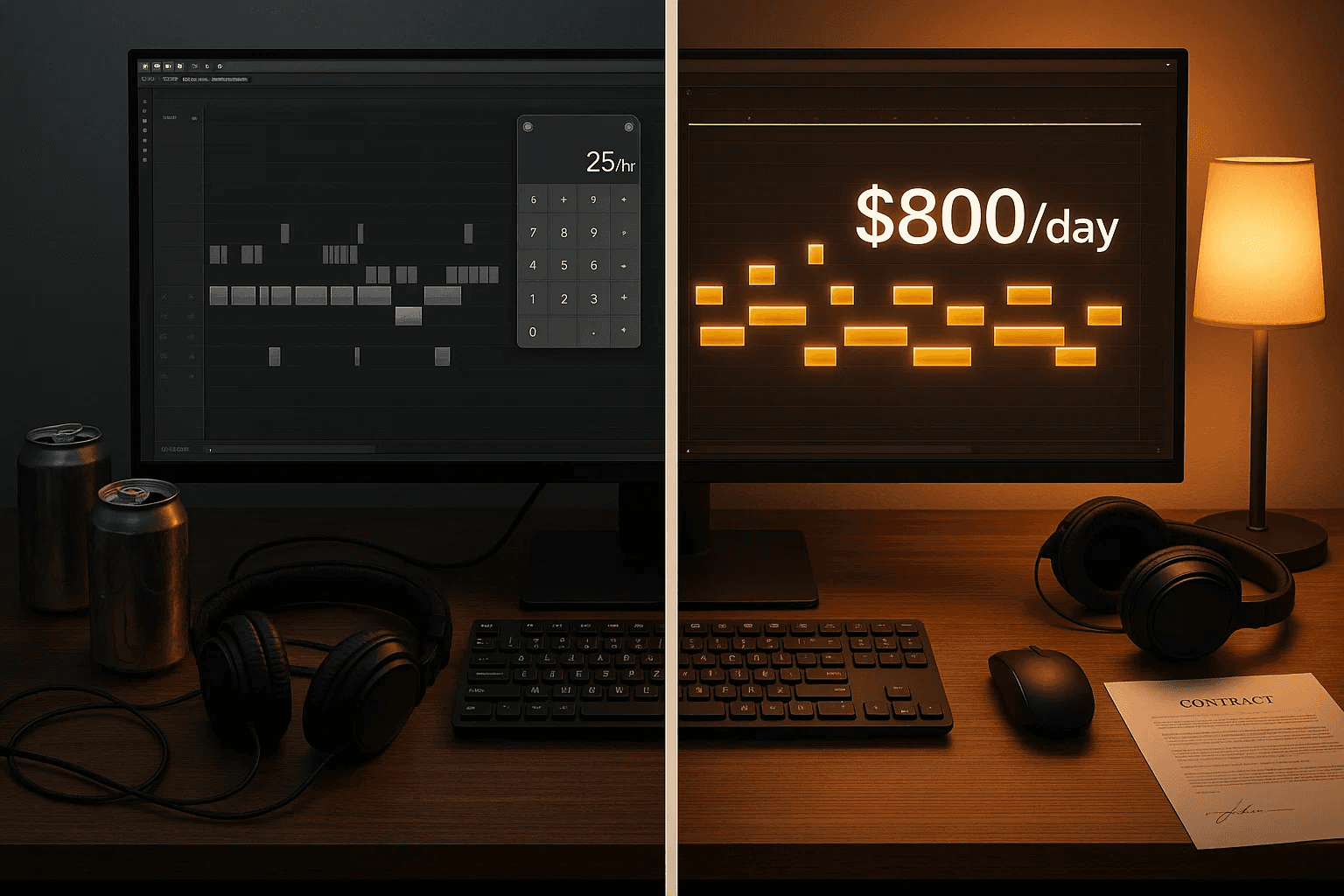
Most video editors stay stuck at beginner rates not because they lack skill, but because they lack leverage. In the real world, your rate isn't just a number, it’s a signal of your value. This guide pulls back the curtain on how 6-figure freelance editors and agency owners actually talk to clients, structured into actionable techniques you can use today.
Part 1: The "Real World" Mindset Shift
Before you send a quote, you need to understand the two distinct worlds of video clients. "Real people" advice from forums like Reddit confirms that treating these two groups the same is a fatal error.
The Two Client Archetypes
Feature | The YouTuber / Creator | The Corporate / Business Client |
Primary Goal | Retention, CTR, Algorithm growth, Speed. | Brand safety, Polish, Invoicing, Reliability. |
Negotiation Trigger | "This video will make you $X in AdSense." | "This will save your marketing team 10 hours." |
Budget Source | Their own pocket (highly emotional). | Company budget (unemotional "use it or lose it" money). |
Best Pricing Model | Flat per-video fee or Monthly Retainer. | Day Rate or Project Fee (50% deposit). |
Pro Tip: Never quote an hourly rate to a YouTuber. They will punish you for being fast. If you edit a vlog in 2 hours that gets 100k views, you shouldn't be paid for 2 hours; you should be paid for the value of those 100k views.
Part 1.5: Stop Guessing. Use Data.
Before you even think about negotiating, you need a baseline. The biggest killer of negotiation confidence is the fear that you are "pulling numbers out of thin air."
You don't need to guess anymore.
We built a Global Video Editing Rate Calculator based on a detailed survey of 200+ professional editors from around the world. It analyzes real-world data based on:
Region (Rates in NYC are different from rates in London or Mumbai).
Video Type (Commercials pay differently than Vlogs).
Experience Level.
Click Here to Use the Video Editing Rate Calculator
How to use this tool for leverage: Use the number this tool gives you as your "Floor Price" (the absolute minimum you will accept). When you get on a call, you aren't just hoping for a fair rate; you know the market standard. That confidence is something clients can smell.
You can also download the same as a PDF to send as quotation to your clients.
Part 2: The Negotiation Toolkit (Techniques & Psychology)
These are battle-tested techniques used by senior freelancers.
1. The "Anchor" Technique
Never let the client set the price first. If you ask "What is your budget?", they will lowball you. Instead, set a high "Anchor" price.
The Concept: If you say "$1,000," and then come down to "$800," the client feels like they won. If you start at "$600" and try to go up, you’ve lost.
2. The Power of Silence
When you state your price, shut up.
You: "For a project of this scope, my fee is $1,500."
Silence (Count to 10 in your head).
Client: "Oh... okay. Well, that's a bit higher than we thought, but..."
Why it works: Amateurs nervously fill the silence with "But I can do it for less if that's too much." Don't negotiate against yourself.
3. The "Menu" Strategy (Tiered Pricing)
Give clients a choice of how to pay you, not if they should pay you.
Option A (Basic): Just the edit. ($500)
Option B (Standard): Edit + Sound Design + Color Grading + 2 Revisions. ($800)
Option C (Premium): All of the above + Source Files + 24hr Turnaround. ($1,200)
Result: Most clients pick Option B. You’ve successfully nudged them up from the minimum without forcing them.
Part 3: Copy-Paste Scripts & Email Templates
Real editors don't wing it. They use scripts.
Scenario A: The Initial Quote (Email)
Subject: Proposal for [Project Name]
Hi [Client Name],
Great chatting with you. Based on our discussion about your goals for [mention their goal, e.g., increasing retention/brand awareness], I’ve put together three options.
Option 1: The Essentials - $X
Includes the full edit and 1 round of revisions. Best for simple updates.
Option 2: The Professional Polish (Recommended) - $Y
Includes the edit, advanced sound design, motion graphics for engagement, and up to 3 revision rounds.
Option 3: The Full Suite - $Z
Includes everything in Option 2 plus social cut-downs (shorts/reels) and raw project files.
Let me know which tier looks like the best fit for your current budget!
Scenario B: Responding to "That's too expensive"
"I completely understand that budget is a factor. The rate is based on the [specific value, e.g., complex motion graphics/fast turnaround] required to get the results we discussed.
If $X is out of range, we can look at reducing the scope to fit your budget. For example, we could remove the motion graphics or limit revisions to one round to bring the price down to $Y. Would that work for you?"
Why this works: You never lower the price without lowering the work. This protects your value.
Scenario C: The "Rate Increase" Letter (For long-term clients)
Hi [Client Name],
I’ve really enjoyed working on [Project] over the last year.
As my business has grown and demand has increased, I’m updating my rates to reflect the current market value and the improved equipment/software I use to deliver your videos.
Starting [Date - give 30 days notice], my new day rate will be $X.
Since you’re a long-term partner, I wanted to give you a heads-up well in advance. I’m excited to keep crushing it for you guys in Q4!
Part 4: The Holy Grail: The Retainer Model
Negotiating a one-off project is good; negotiating a retainer is wealth. This is where you trade availability for guaranteed income.
How to Pitch It:
Don't sell "hours." Sell "priority."
The Pitch: "I noticed we are doing about 4 videos a month individually. It might be cheaper and easier for you to switch to a monthly retainer. It guarantees you my availability (so you skip the line) and gives you a flat monthly cost for budgeting."
The Structure (Example):
Deliverables: 4 YouTube Videos + 4 Shorts per month.
Cost: $3,000/month.
Terms: "Use it or lose it" (unused videos don't rollover), 30-day cancellation notice.
Part 5: Real World Examples (Case Studies)
Case Study 1: The "Corporate" Pivot
The Editor: Sarah, Freelance Editor.
The Situation: She was charging $50/hr but clients kept nitpicking her hours ("Why did this take 3 hours?").
The Negotiation: She switched to a Day Rate of $650.
The Script: "I don't bill hourly because it penalizes efficiency. My day rate is $650, which covers all equipment, software, and revisions. This way, you know exactly what the invoice will be upfront—no surprises."
The Result: Clients loved the predictability. She made more money and stopped tracking minutes.
Case Study 2: The YouTuber "Revenue Share" Trap
The Editor: Mike, Gaming Editor.
The Situation: A client with 500k subs offered him "% of revenue" instead of cash.
The Negotiation: Mike knew revenue is unpredictable. He countered with a Hybrid Model.
The Counter: "I can't pay my rent with potential views. However, I can do a lower base rate of $200 per video + 10% of AdSense revenue for the first 30 days."
The Result: He covered his baseline needs, but when one video hit 2M views, he made a $2,000 bonus.
Conclusion: The "Walk Away" Number
The most powerful negotiation tactic is the ability to say "No." Before every call, write down your "Walk Away Number." If the client can't meet it, politely decline.
Script: "It sounds like we might not be a match on budget right now, and I wouldn't want to do a disservice to the project by rushing it to fit that figure. If your budget opens up in the future, I’d love to chat again!"
Often, this confidence is exactly what makes them call you back 10 minutes later agreeing to your price.